
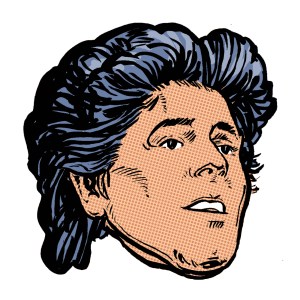
Colette Magny (CHANTEURS ET CHANTEUSES)
35 Av. de Flandre, 75019 Paris, France
And
52 Av. de Flandre, 75019 Paris, France
Unlike other singer-songwriters of the era, Colette Magny began her professional singing career as she approached middle age. She released her first studio album at the age of 38. She became known for her unconforming appearance, rebellious lyrics and protest songs. Although she scored a hit with her 1963 song Melocoton, she was often neglected by the mainstream media. In 1963 she did reach the attention of the wider public after appearing on the French variety programme Petit Conservatoire de Mireille. It gave her the opportunity to play the support slot for Sylvie Vartan at l’Olympia in the same year. There is a street and school named after her in the 19th arrondissement, situated to the North of these two addresses.
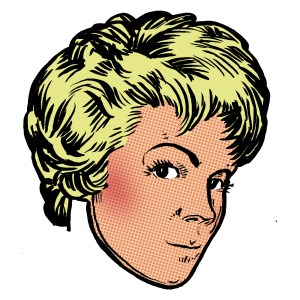
Marie-Hélène (Mme Piot) (CHANTEURS ET CHANTEUSES) and Paul Piot
19 Rue Riquet, 75019 Paris, France
Singer Marie-Hélène initially released records under her own name, Marie Nell, but unfortunately a singer of greater reputation used the same name in Belgium. A quick turnaround and the persona of Marie-Hélène was born with a series of EPs on the Vega label. It was a brief career from the late 1950s to the mid 1960s. In the 1965 Guide du Show Business she lists her name under the title Madame Piot. Her husband, one would presume, was the bandleader Paul Piot, whose orchestra accompanied her on many of her records.
Robert Blandinieres (CHANSONNIERS)
63 Quai de la Seine, 75019 Paris, France
Singing comedy duo Les Blandinieres (Robert and Suzanne) were Montmartre favourites during the 1930s, performing at Théâtre d’Avant-garde Populaire and the famous Chat Noir in the 18th arrondissement. Their repertoire included duets, monologues, fanciful scenes and operetta skits. In 1927 Robert Blandinieres appeared in Léo Poldès’ play L’Eternel Ghetto at the Théâtre du Journal.
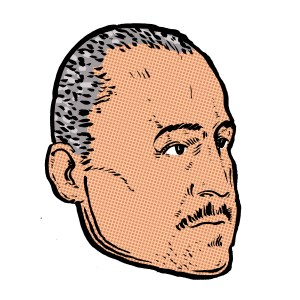
Dante Agostini (Batterie)
7 Rue Duvergier, 75019 Paris, France
In 1965, Dante Agostini co-founded with Kenny Clarke the drum school École de Batterie Dante Agostini – Kenny Clarke. Agostini developed a comprehensive learning method for the drums, from beginner to professional. The “méthode Agostini” boasts a portfolio of more than thirty booklets, CDs and vinyl. They continue to be bestsellers in France. He began playing drums and accordion at the age of five and performed at a local ballroom in his family orchestra until being conscripted into the compulsory work service during World War II. After the war he began drumming professionally with accordionist Joss Baselli before moving to Montmartre and joining Jacques Hélian’s orchestra in 1952. He then entered the Olympia orchestra, where he played alongside Frank Sinatra, Jerry Lewis, and Charles Trenet, and later entered the Folies Bergère orchestra. After shows he played in jazz clubs, where he met visiting American musicians such as Miles Davis, Dizzy Gillespie, and Milt Jackson, whose Hard bop music inspired his teaching methods.

Colette Cotti (PRODUCTEURS ET PRESENTATEURS DE L’O.R.T.F.)
119 Av. de Flandre, 75019 Paris, France
Colette Cotti made her name as a theatre actress before becoming a presenter and producer on French TV. She made her debut on the stage in 13 pièces à louer at the Théâtre du Quartier Latin in Paris, and was active throughout the 1950s. Her theatrical career brought her into contact with director and screenwriter Claude Santelli. She appeared in two of his plays, La Famille Arlequin (1956) and Lope de Vega (1959), the latter was her final swansong on the stage. For the next 10 years Cotti worked alongside Santelli on the educational TV programme Livre mon ami, introducing young people to the joys of literature. A regular face on TV during the 1960s and 70s, she also produced programmes for young people, such as Clignotant. She published a number of books on the same subject: La femme au seuil de l’an 2000 (1968); Je réponds à mon enfant de 10 à 18 ans (1969); and Répondre aux enfants jusqu’à l’adolescence (1979).
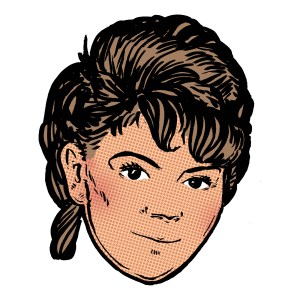
Michel et Monique (CHANTEURS ET CHANTEUSES)
119 Av. de Flandre, 75019 Paris, France
French duo Michel et Monique were painter and singer Michel Murty and actress Monique Brienne. During their short lived partnership they released just one album, Mirabeau Mirabelle (1969) and a few EPs.
Monique Brienne made her acting debut in Jean-Paul Sartre’s Les Mains sales in 1949, and her final stage appearance in L’Idée d’Élodie at the Théâtre Michel in 1962.
Michel Murty studied at the L’école Estienne in the 1950s, where he won first prize for his draughtsmanship, and also formed his first band, a harmonica trio. He worked at the magazine l’Illustration until he turned professional in 1967, releasing his first single with Monique Brienne. During this time he exhibited his paintings at the Grand Prix International de Deauville, La Galerie du Passeur, and at the Grand Palais des Champs-Elysées in the Salon des Artistes Français. As a duo, Michel et Monique supported Georges Brassens at Bobino and toured Polynesia, before going their separate ways in 1973.
Anne-Marie Sanial, coloratura (ARTISTES LYRIQUES)
119 Av. de Flandre, 75019 Paris, France
Opera singer Anne-Marie Sanial was a coloratura soprano who made her debut in Jacques Offenbach’s La Belle Hélène at the Festival de Lyon-Charbonnières in 1959. Over the next 20 years she was a popular performer across France, appearing in operas from Bordeaux (Grand Théâtre de Bordeaux) to Paris (Théâtre du Palais-Royal). In the 1960s she was in productions at the Théâtre municipal de l’Opéra (Nice) and the Théâtre-Maison de la Culture (Caen). A highlight of her career was playing Rosina in the Barber of Seville in 1964, at the Théâtre de la Sinne à Mulhouse.
Max Sautet (PRODUCTEURS ET PRESENTATEURS DE L’O.R.T.F.)
32 Rue de l’Ourcq, 75019 Paris, France
Journalist and director Max Sautet specialised in documenting all aspects of bullfighting on film. He cut his cinematic teeth in the late 1950s on nature documentaries and tourist board films. In 1962 he directed Panem et Circenses, a short film about the annual Pamplona Festival, where the bulls run through the streets. He followed this up with two reports for the monthly sports news television programme Les Coulisses de l’exploit, broadcast on the ORTF channel. The first in 1963 features the raseteurs of the Camargue, and then in 1964 an episode dedicated to El Cordobés, the most famous bullfighter of the time. He also introduced the French public to some of the lesser known bullfighting personalities, reporting on the lives of the young apprentices (maletillas). In 1993 he published the book Les Heures de la Corrida: vu du Callejon.
Charles Dobzynski (poète)
6 Rue de Nantes, 75019 Paris, France
Poet, journalist and translator Charles Dobzynski emigrated to France when he was a year old. He narrowly escaped deportation during World War II, with his family having to go into hiding. He published his first poem in 1944, in the youth newspaper of the Resistance, Jeune Combat. In 1949, Paul Eluard presented his first poems in Les Lettres françaises. On the proposal of Louis Aragon, he joined the editorial staff of the daily newspaper Ce Soir. He was a journalist and critic, with a passion for astronautics, cinema and poetry. From the beginning of the 1970s he was an editor of the magazine Europe. He is a Chevalier de l’ordre des Arts et des Lettres, a member of the Académie Mallarmé, and president of the jury for the Prix Guillaume-Apollinaire.

Roméo Carlès (CHANSONNIERS / COMÉDIENS)
13 Quai de l’Oise, 75019 Paris, France
Algerian comedian Roméo Carlès was one of the great chansonniers on the Parisian scene, proving that you didn’t need to be a Montmartrois to rise to the top. He started at a young age, touring France with his father, an artisan blacksmith who reinvented himself as a tenor. Young Carlès would make his debut as an 8 years old on the stage of the Trianon-Lyrique, the famous venue in Paris’ 18th arrondissement. He dreamt of becoming a painter but the lure of capital’s cabarets was too strong. He would go on to be a regular performer on the stages of the Coucou, Dix Heures, Caveau de la Republic, Lune Rousse, and the Chat Noir, where he first appeared in 1920. He was a popular radio star and appeared in a number of films during a 30 year cinema career (1933-1964). He wrote and published his jokes in the comic books Blagues and Franc-Rire during the 1950s and 60s.
See an object relating to Roméo Carlès HERE.
 Guide to Paris Show Business
One response to “Walk 41 – Crimée”
[…] Find out where Roméo Carlès lived on Walk 41 – Crimée […]
LikeLike